Keeping a warehouse cool is a different and more complex challenge from cooling an office.
High ceilings, large open spaces, loading bays, complex machinery, and fluctuating occupancy levels all create a unique set of challenges for facilities managers.
Without the right warehouse air conditioning in place, warehouses can rapidly get uncomfortable, highly inefficient, and difficult to operate during the warmer months.
Modern warehouse cooling systems improve temperature control, energy efficiency, reliability, and comfort across large-scale commercial and industrial settings.
Whether you’re operating a distribution centre, logistics hub, pharmaceutical warehouse, or manufacturing facility, having the right cooling system in place should be among your leading priorities.
Why warehouse cooling is different from office air conditioning
Warehouses are high-volume environments that can experience significant heat gain from machinery, lighting, production processes, and solar exposure.
Warm air can rise under high ceilings, collecting at roof level and creating uneven temperatures throughout the building.
Warehouses also face additional challenges like:
- Frequent door openings at loading bays
- Variable occupancy and operating hours
- Limited insulation in older buildings
- Heat generated by equipment or stored goods
- Large open-plan spaces requiring even airflow
Specialist warehouse cooling systems are engineered specifically to meet these challenges, making them different to standard office air conditioning systems.
ICE delivers tailored warehouse air conditioning solutions designed for facilities, ranging from small storage units to large national distribution centres.
Types of warehouse cooling systems
There are several options available when designing an industrial air conditioning warehouse installation.
The most suitable choice will depend on building size, operational requirements, occupancy, and budget.
Evaporative cooling systems
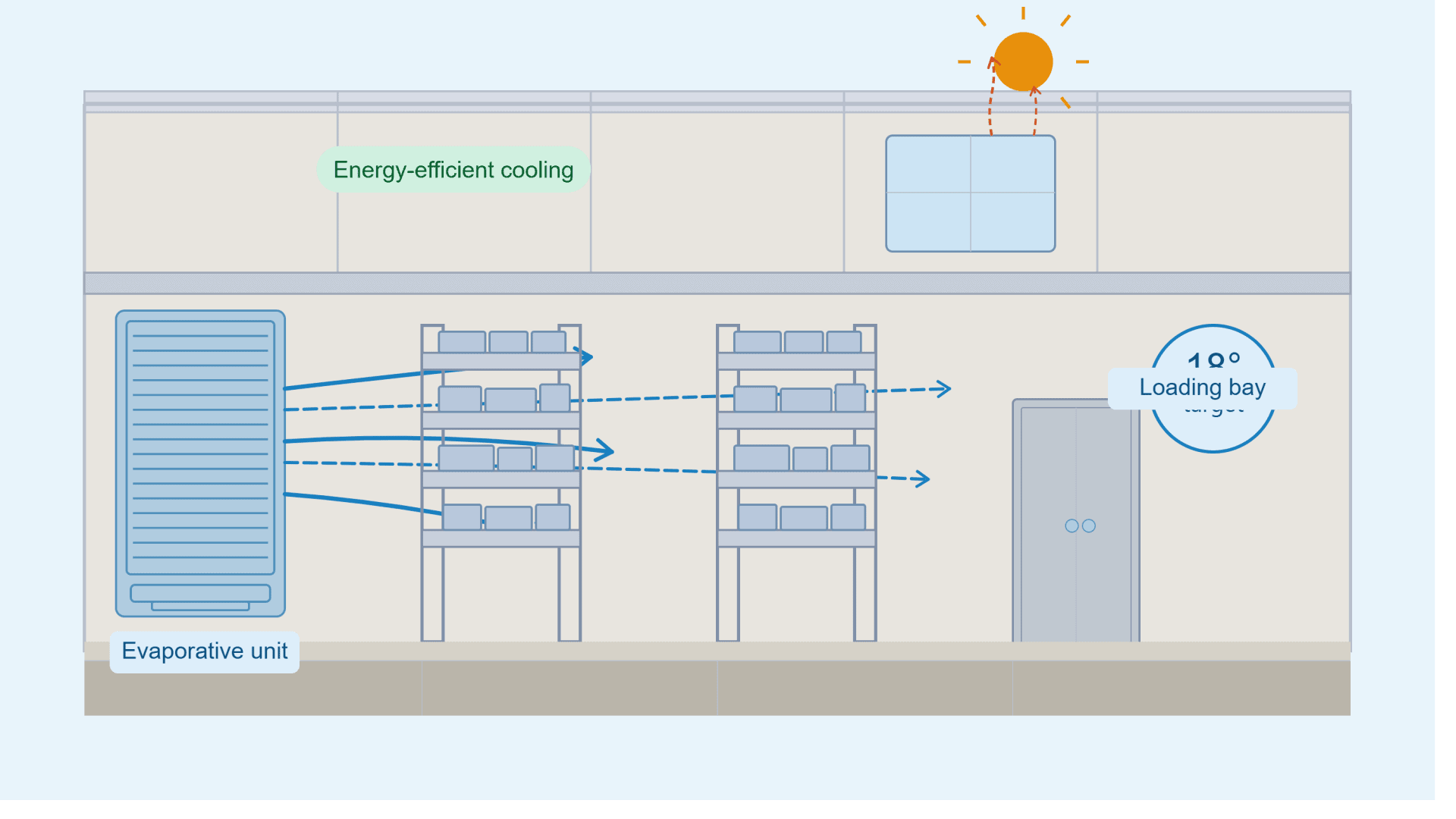
Evaporative cooling works by drawing warm air through water-saturated pads.
This naturally lowers the air temperature before distributing it throughout the warehouse.
Benefits include:
- Low running costs
- Energy-efficient operation
- Continuous fresh air supply
- Suitable for large open spaces
Evaporative cooling is particularly popular in warehouses and manufacturing facilities because it can cool large areas more economically than traditional refrigeration-based systems.
Learn more about evaporative cooling systems for warehouses and industrial spaces.
Split Air Conditioning Systems
Split systems are ideal for smaller warehouses, offices within warehouses, or isolated cooling zones. They provide direct refrigerant cooling (DX cooling) and precise temperature control.
VRF/VRV Systems
VRF systems are best suited for more complex buildings requiring multiple independently controlled zones.
These systems are energy-efficient and flexible but may be less practical for very large open warehouse areas.
Destratification Fans
Destratification fans help redistribute warm air trapped at ceiling level, improving heating and cooling efficiency throughout the warehouse.
They’re often used alongside other cooling systems to improve airflow and reduce energy waste.
Evaporative Cooling vs DX Cooling
When considering warehouse air con, one of the most important decisions is whether to use evaporative cooling or direct expansion (DX) refrigeration cooling.
How do they differ and what are their respective advantages?
Evaporative cooling
- Lower installation and operating costs
- Highly energy efficient
- Best suited to large open warehouses
- Provides fresh air ventilation
- Less effective in highly humid environments
DX cooling
- More precise temperature control
- Better suited to enclosed or temperature-critical spaces
- Higher running costs due to refrigeration systems
- Suitable for offices, healthcare, and specialist applications
To strike a balance between comfort and efficiency, hybrid solutions that combine evaporative cooling with mechanical ventilation or DX systems can be a good choice.
Energy efficiency considerations
The costs of keeping a warehouse cool can be considerable, so energy efficiency must be a priority in cooling design.
As well as helping businesses reduce their expenses, it also enables them to become more sustainable.
Factors that can impact warehouse cooling efficiency include:
- Building insulation quality
- Roof and wall heat gain
- Air leakage through loading bays
- Equipment efficiency ratings
- Smart controls and zoning
- Ventilation and airflow design
Modern warehouse cooling systems can significantly reduce energy usage when properly designed for both the building and operational requirements.
If you’re planning a larger installation, air conditioning finance options can allow you to spread the costs of the project and budget effectively.
Pharmaceutical warehouse cooling: What you need to consider
Pharmaceutical warehouses where medicines, healthcare products, and temperature-sensitive materials are stored require a careful approach to cooling that meets health and safety requirements.
Specialist considerations include:
- Temperature mapping and validation
- Continuous monitoring and alarms
- Redundancy and backup systems
- Controlled temperature ranges
- Audit-ready reporting and compliance documentation
ICE is a trusted provider of specialist air conditioning services for the pharmaceutical sector.
We enable our partners in the pharmaceutical industry to have the kind of close control and reliability they need to operate effectively in line with regulations.
What affects warehouse air conditioning costs?
Warehouse air conditioning costs vary significantly depending on the size of the project, what’s being stored, and the type of building.
Key components of overall cost will include:
- Building size and ceiling height
- Insulation levels
- Cooling method selected
- Occupancy levels and operating hours
- Number of loading bays and doors
- Temperature requirements
- Existing infrastructure
Larger warehouses will often require bespoke system design, making site surveys and heat-load calculations essential before any accurate pricing can be provided.
What does the installation process involve?
A typical warehouse cooling installation will include:
- Initial site survey and heat-load assessment
- System design and equipment specification
- Airflow and ventilation planning
- Installation of cooling equipment and controls
- Commissioning and performance testing
- Ongoing service and maintenance support
The timescales for projects will vary depending on the size of the building and the complexity of the system.
Experienced contractors will look to minimise disruption to daily operations wherever they can.
At ICE, we work to ensure minimal interruption to operations throughout the installation process.
Warehouse air conditioning FAQs
Is evaporative cooling suitable for UK warehouses?
Evaporative cooling is widely used in UK warehouses and industrial buildings because it offers energy-efficient cooling for larger open spaces.
How much does warehouse air conditioning cost?
Costs will vary depending on building size, cooling requirements, insulation, and the type of system installed.
How long does warehouse AC installation take?
Smaller systems may take only a few days, while larger industrial projects can take several weeks depending on their complexity.
Arrange a free warehouse cooling survey
ICE installs cooling systems for warehouses ranging from 500m² to 50,000m²+ across the UK.
Our experienced engineers design solutions that are tailored to the building and its operational requirements.
Arrange a free site survey today to discuss the right warehouse air conditioning system for your facility.
You may also like...
What is a TM44 inspection?
So what is a TM44 Inspection? Well, today we are going to go over everything that you need to know....
Read More
Air conditioning maintenance contracts explained: What’s included and what to look for
Whether you manage offices, retail premises, healthcare facilities, or industrial environments, air conditioning is increasingly integral to your daily operations. ...
Read More